Applications of AI for Predictive Maintenance
 NVIDIA DLI
November 6, 2026
The program
NVIDIA Deep Learning Institute's "Applications of AI for Predictive Maintenance" workshop is about detecting and predicting hard-drive failures from sensor time series (Backblaze S.M.A.R.T. data). Over about 8 hours of Jupyter labs on NVIDIA GPUs, I compared three GPU-accelerated approaches: XGBoost with RAPIDS cuDF, LSTM / CNN-LSTM recurrent networks, and autoencoders for anomaly detection.
- Issuer
- NVIDIA · Deep Learning Institute (DLI)
- Issued on
- November 6, 2026
- Format
- Hands-on workshop of about 8 hours, Jupyter labs on NVIDIA GPUs (Tesla T4)
- Validation
- Graded coding assessment: 100% (passing score: 90%)
- Signed by
- Howard Wright, Vice President, NVIDIA
- Certificate ID
The certificate
Open full size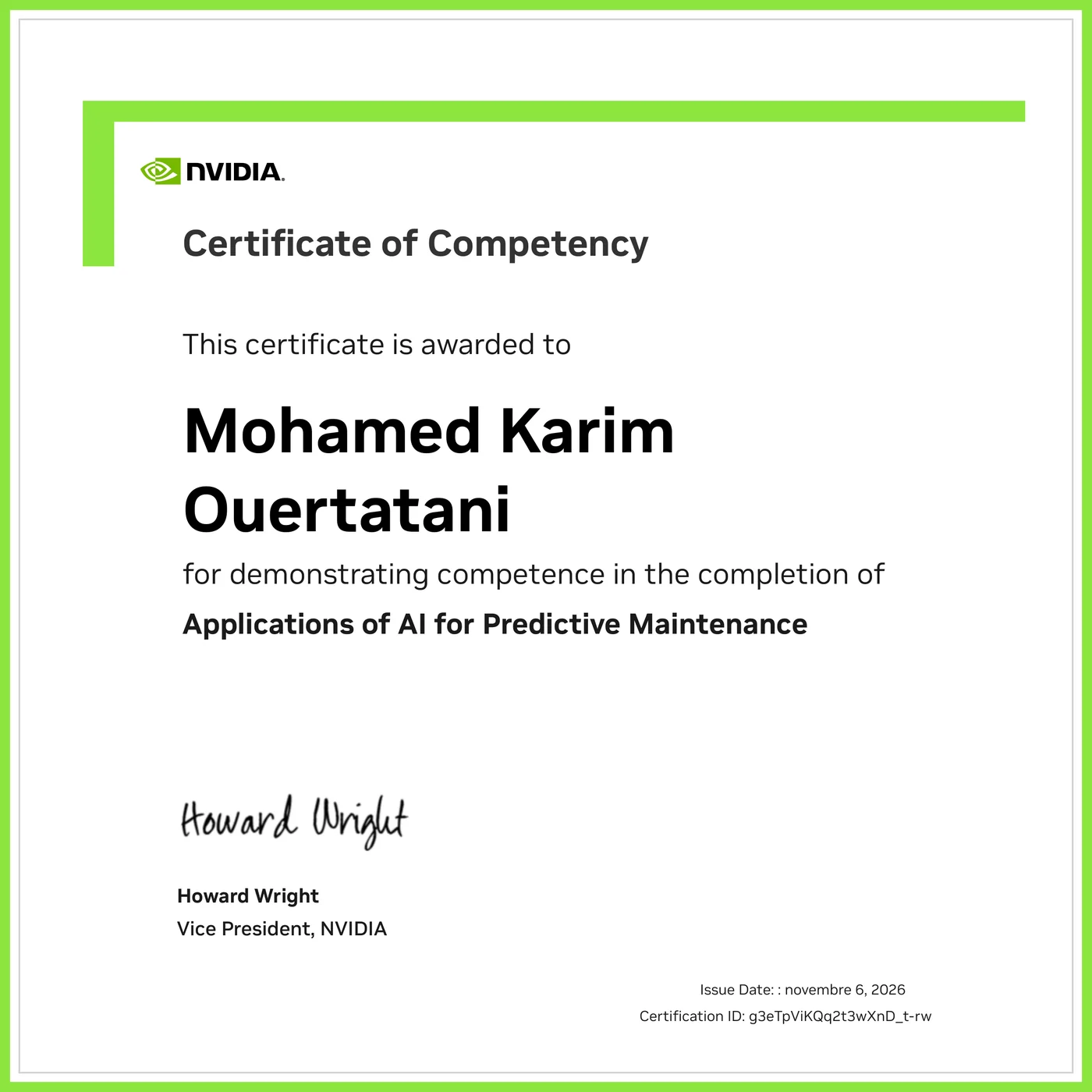
Curriculum
- 01XGBoost on GPU with RAPIDSCleaning a dataset of over 30 M rows, narrowed to a single drive model (ST4000DM000), then GPU-accelerated XGBoost
- 02LSTM and CNN-LSTM for time seriesPer-drive sequences (sliding window, lookahead, forward fill of missing days), stacked LSTMs then CNN-LSTM
- 03Autoencoders for anomaly detectionLSTM autoencoder and 1D convolutional autoencoder, compared with ROC / AUC and tuned with Bayesian optimization
Graded coding assessment
Build a model that predicts the next vector of a multivariate series (2 LSTMs of 128 units, Dense 256 tanh, Dropout 0.2, Dense 128 tanh, then an output the size of the features). Score: 100% (passing score: 90%).
Skills gained
XGBoost on GPU with RAPIDS
Training on CPU, on GPU, then on GPU with cuDF: from 59 s down to 13 s, about 4.5× faster
Highly imbalanced classes
About 0.009% failures: with undersampling, recall on the failure class rises from 0.03 to 0.72, with a precision of 0.97
LSTM and CNN-LSTM
Stacked LSTMs with dropout and L2 regularization, trained on multiple GPUs (MirroredStrategy), then a 1D-convolution variant
Anomaly detection
Autoencoders trained on healthy drives only, an anomaly flagged when the reconstruction error (MSE) exceeds a threshold
Model evaluation
Precision, recall, F1-score, ROC curve / AUC, and the limits of accuracy on imbalanced classes
Bayesian optimization
Tuning layer width and learning rate with bayes_opt, on both autoencoder architectures